Showing posts with label Tax. Show all posts

Tuesday, December 31, 2013

A Pretty Good Year, Too

0 comments
Major indices were up at least 20%. Meanwhile, Apple's price recovered from its summer bottom
to finish 2.18% higher by Dec. 31st. Including dividends, that was a return of 4.4%; really, not so bad.
By far the biggest factor behind income inequality is wealth inequality. A mega-rich mogul's billion dollars of stock holdings at the beginning of 2013 are very likely to have grown by at least $200 million (20%) by year-end, all without him or her spending an hour at the office.

On a much more common and achievable scale, it's entirely possible for a middle-class working couple to have accumulated one million dollars in investable funds by the time they are in their 50's through a program of regular saving. Here's one scenario among an infinite number: new annual savings start at $7,000 and increase by 3% per year to $16,496 in year 30; the total put away would be about $333,000. Meanwhile, if the couple earned 8% on their investments (the S&P 500 increased by an average of 10% per year from 1975 to 2013), the portfolio would have grown to $1,069,000.

The above is an extremely simplistic example, because we're not considering the negative effect of income taxes (although if the funds are stored in tax-deferred 401(k) or IRA accounts taxes are not a factor until funds are withdrawn), nor are we considering the positive effect of dividends. The point of the exercise is to show that getting to $1 million is doable, and so was enjoying at least a $200,000 increase in one's portfolio in 2013.

Billionaires are leaving everyone behind, but if they can put aside the sin of envy many will come to realize that they had a pretty good year, too. © 2013 Stephen Yuen

Friday, December 27, 2013

There's No Better Time

0 comments
At this time of year the financial publications are rife with advice about income taxes. Usually the emphasis is on reducing taxes in the current year through taking deductions such as charitable contributions or dramatic steps such as moving to a low-tax state or getting married. This year, however, is different, and not just because tax rates are going up; the increase in complexity has been exponential.
With the introduction of the 3.8% net investment income tax (Sec. 1411), and the return of the 20% capital gains rate (Sec. 1(h)) and the 39.6% income tax rate (Sec. 1(i)), America shifted overnight at the start of 2013 from a two-dimensional tax system to a four-dimensional system. [snip]

The complexity of going from a two-dimensional system to a four-dimensional system is exponential, not linear, and requires a quantum leap in tax analysis methodology, tax strategy, and tax planning software tools.
It may only seem that the vast majority of Americans will not have to deal with this complexity; only if a married couple has income over $250,000 (or a single person over $200,000) will they be subject to the investment-income tax.

However, more people will be affected than just the supposedly "rich". As taxpayers approach these income thresholds, many will scale back their economic activity to avoid crossing them, just as small businesses avoid having more than 49 employees to escape the penalties of Obamacare.

Also, the interconnection between income and estate/gift taxes has become much more complicated. It is easy to be unconcerned about the problems of "wealthy" estates, which pay taxes if they are valued at more than $5.34 million, but it wasn't that long ago that having a $1 million estate was an uncommon experience.

In the view of your humble observer, society underestimates the cost of complexity. We regularly come across productive individuals---doctors, accountants, businesspeople---of a certain age who don't mind paying somewhat more in taxes; they hate the hassle of new regulations that have nothing to do with their fundamental business operations. So they are cutting back or quitting altogether. The silver lining--for them, not society--is that if they have been thinking about doing something else with their lives, there's no better time. © 2013 Stephen Yuen

Sunday, October 20, 2013

O, the Humanity (Reprise)

0 comments
I cut a lot of slack to politicians when they make predictions. I may think that they're dead wrong when they claim, for example, that lower government spending or higher taxes are the way to solve the debt problem. But they probably aren't "lying", i.e. knowingly spouting something untrue; they may be indulging in wishful thinking---heck, they may even believe with all their heart in what they're saying.

But when politicians say something utterly false--and they know it--concerning past events, the normal reaction is to get angry (perhaps because people don't like the answer to "what kind of fool do you take me for?"). However, the explanations can be so laughable that their ridiculousness disarms us.

Every six months or so the Obama Administration is good for such a howler that I can't be angry at them.

September, 2012 - the attack on the American consulate in Libya, as well as uprisings across the Middle East, was due to an obscure YouTube video. President Obama, on 9/12/12:
"What we do know is that the natural protests that arose because of the outrage over the video were used as an excuse by extremists to see if they can also directly harm U.S. interests."
May, 2013 - the IRS targeting of tea party organizations was the work of low-level agents in Cincinnati:
the IRS has identified two "rogue" employees in the agency's Cincinnati office as being principally responsible for the "overly aggressive" handling of requests by conservative groups for tax-exempt status
October, 2013 - the first reason (the President did list others later in his 10/21/13 press conference) that the Obamacare website doesn't work:
"the number of people who have visited the site has been overwhelming, which has aggravated some of these underlying problems."
An amateur video, Cincinnati IRS agents going rogue, and healthcare.gov being so popular the website froze. Laughter being the best medicine, the President is correct about one thing: because of Obamacare many of us are feeling better already. © 2013 Stephen Yuen

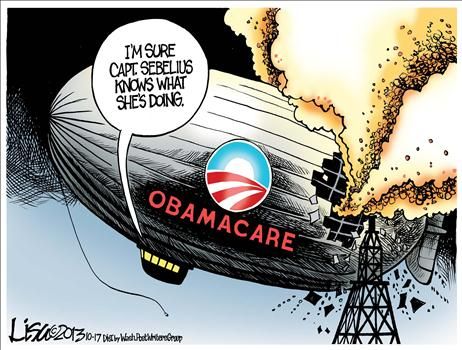
Lisa Benson cartoon

Wednesday, October 9, 2013

A Plausible, Good Deal

0 comments
Peggy Noonan on the "strange shutdown":
Republicans, who hate big government, are fighting to keep it open, and Democrats, who love big government, are fighting to keep it closed.
The Republicans want to fund everything but Obamacare, which is a sacred cow to Democrats; hence the impasse.

In the short run everyone in Washington is looking bad, and the Republicans are looking worse. If this goes on much longer, however, the majority of Americans may find that they're getting along just fine if Washington is closed. Big government advocates are running a huge risk: benefits and taxes both stopping looks more and more like a plausible, good deal.

Thursday, September 5, 2013

Not Balanced

0 comments
Insights about the surveillance society [bold added]:
Princeton computer-science professor Edward Felten explained that this tremendous growth in storage capacity would inevitably spur intelligence agencies to collect all available data—everything—simply because it’s cheaper and easier than trying to figure out what to take and what to ignore. “If storage is free but analysts’ time is costly, then the cost-minimizing strategy is to record everything and sort it out later,” Felten noted. [snip]

The more technology endangers our privacy, the less we seem to prize it. We post family photos on social-media sites and ship our credit-card numbers to total strangers. We ask websites we’ve never visited—designed by people we’ve never met—to give us advice on treating embarrassing maladies and hunting for potential mates. But the government is different, as [National Intelligence general counsel Robert] Litt acknowledged in his recent speech, because “the government has the power to audit our tax returns, to prosecute and imprison us, to grant or deny licenses to do business and many other things. And,” he continued, “there is an entirely understandable concern that the government may abuse this power.”
The writer, David von Drehle, tries to end on a hopeful note:
This, ultimately, may prove to be our strongest protection against the rise of the surveillance state. The same tools that strengthen it strengthen those who protest against it. Privacy is not the only illusion in the new age of data; government secrecy is too. Big Brother might be watching, but he is also being watched.
However, as the article pointed out earlier, police, taxing, regulatory, and/or subpoena power resides with the government and private citizens have very little resources to counterbalance it. Knowledge is powerful, but knowledge needs a lot of help. © 2013 Stephen Yuen

Monday, August 12, 2013

Will Medical Insurance Pay for my Cellphone?

0 comments
That's not such a far-fetched question, given the increased use of cellphone cameras and apps by patients.
The simple camera phone is epochal in that it puts the power—literally—into the hands of patients. The photographic possibilities extend far beyond the skin. In the pediatric gastroenterology clinic, many concerned parents bring in photos of their kids' dirty diapers, which all parties agree is vastly preferable to bringing in the real thing. Some neurologists recommend that parents make videos of children who have a known history of seizures to help the team fine-tune medication doses. In developmental and behavioral clinics, parents can show videos of their children at home demonstrating milestones like a mature pincer grasp or pulling to stand.
If the insurance company won't pay, perhaps one can still claim an itemized deduction for "medical equipment." The expense shouldn't be hard to corroborate, since the IRS will have copies of all your medical records and photos.... © 2013 Stephen Yuen

Wednesday, June 5, 2013

"The Worst Tax Season Ever"

0 comments
A bounce from the bad feelings: ecstasy when it's over.
It's been said that CPA's like our complicated tax system just fine because the system allows them to bring in more revenue. Why is it, then, that many have left or are leaving the tax preparation business? A sampling of comments from the "worst tax season" ever:
easy or quick returns are being done by the taxpayer online.....complicated returns, while expensive to the client, usually work out to a worse hourly rate for the accountant.

The rules don’t get finalized until late in the year. That causes the information to come out later every year. And the financial institutions are issuing 2 and 3 amended reports after the originals are issued. As recently as 5 years ago, I used to do 2/3 of my returns in February. Now the last 2 years I do 2/3 after March 15.

New Mexico Taxation and Revenue and the Department of Workforce Solutions decided to mandate all businesses e-file unemployment, state workers comp fee and witholding for the period ending 12/31/12. The kicker was, the system had never been tested and still doesn’t work. I am still struggling with filing P/R tax reports and penalties assessed because New Mexico can’t get a system that works. More returns on extension than ever before and no end in sight!

Absolutely the worst – a good deal due to Congress late changes and updates requred by IRS and software vendors. But for me mainly due to major software problems with [.....] unrelated to the late updates.
The regulatory state insists that the governed meet all the deadlines that it imposes though it is late holding up its end of the bargain. It does not allow the governed to deviate from the proliferating rules that it refuses to impose on itself. With experienced tax practitioners departing the business, non-expert taxpayers who need outside help have fewer resources to call on and are more likely to make mistakes or, worse, don't bother to comply at all.

And so it goes in the 21st-century land of the free. © 2013 Stephen Yuen

Saturday, June 1, 2013

Jean Stapleton (1923-2013)

0 comments
All in the Family was the top-rated series on television from 1971 to 1976 for good reason. The writing was sharp and funny, each episode dealt with contemporary controversial topics, and the principal characters, though they began as stereotypes, became richly fleshed out over the series' run. Above all the actors were outstanding, none more so than Jean Stapleton, who died today at the age of 90.

Ms. Stapleton played Edith Bunker, the "dingbat" whom Carroll O'Connor's Archie Bunker verbally abused but deeply loved. Edith was the naive innocent who always assumed that everyone had pure motives. With great discipline the magnificent actress Jean Stapleton never broke character and always delivered her lines with wide-eyed innocence. By never revealing that she was in on the joke, she sometimes got the biggest laughs.

In honor of current events, below is an excerpt (2:33 on the YouTube clip [update 6/7 oops, removed due to copyright claim]) from Archie's Fraud, when Archie didn't report income on his tax return:
Archie, reacting to daughter Gloria and son-in-law Michael greeting each other with a deep kiss: "you don't see me coming home and slobbering all over your mother."

Edith: "that's right, Gloria, your father was never much of a slobberer.....He's more of a pecker!"
Jean Stapleton in 1972 sounded very much like a college-age feminist in 2013: "What Edith represents is the housewife who is still in bondage to the male figure, very submissive and restricted to the home. She is very naive, and she kind of thinks through a mist, and she lacks the education to expand her world. I would hope that most housewives are not like that." R.I.P.

Thursday, May 30, 2013

It's Different This Time

0 comments
Peggy Noonan on why the IRS scandal is different this time, even if other Presidents used the agency for political purposes [bold added]:
The abuse was systemic—from the sheer number of targets and the extent of each targeting we know many workers had to be involved, many higher-ups, multiple offices. It was ideological and partisan—only those presumed to be of one political view were targeted. It has a single unifying pattern: The most vivid abuses took place in the years leading up to the president's 2012 re-election effort. And in the end several were trying to cover it all up, including the head of the IRS, who lied to Congress about it, and the head of the tax-exempt unit, Lois Lerner, who managed to lie even in her public acknowledgment of impropriety.
The Internal Revenue Service may not pack the most firepower (although some of its staff are armed), but it is one of the most powerful and feared government agencies. The IRS has information on nearly every American and has
extensive and unique powers to investigate and examine private records, powers that in many cases contravene the protections otherwise afforded individuals against illegal searches and seizures, self-incrimination, and the right to counsel provided by the Fourth, Fifth, and Sixth Amendments.
Undoubtedly there will be calls for new restraints to be placed upon the IRS. However, the most effective controls will be more than legal; it took generations for venerable institutions like the U.S. Armed Forces, the FBI, and the Secret Service to develop cultures that enabled them to perform professionally (for the most part) no matter who was in charge, and to be circumspect about the use of force.

There is a growing realization that IRS agents, who assume everyone is guilty unless innocence is proved, do not have an institutional ethos to dial back the use of their full power. And when that power is brought to bear exclusively against Administration opponents while supporters are given a pass (though the tax attributes may be similar), then civic society is in danger of flying apart. Peggy Noonan is right: "That is the kind of thing that can kill a country, letting half its citizens believe that they no longer have full political rights." This has got to be redressed, with all deliberate speed. © 2013 Stephen Yuen

Saturday, May 25, 2013

In Praise of Divided Government

0 comments
It's a cliché that the party who holds the White House deplores divided government, while the party out of power likes it very much. The principal objection to divided government is that quick, bold, necessary actions are stymied. To this humble observer that's a feature, not a bug.

When the Democrats had control of Congress and the White House from 2008 to 2010, they passed Obamacare without a single Republican vote. When the Republicans were similarly situated in 2003 to 2006 and part of 2001, they passed the so-called Bush tax cuts, arguably a major source of today's deficit problems. (It should be noted that Democrats were roughly split on the Patriot Act and Iraq War resolutions, so it's a reasonable supposition that even if congressional Democrats had slim control, George W. Bush would have gotten his legislation through, thanks to solid Republican support.)

Now we are seeing another advantage of divided government: congressional hearings on possible Administration malfeasance. Yes, investigations into the current raft of scandals are interfering with Executive Branch operations, and yes, there is grandstanding and partisan obstructionism going on, but there are also important issues at stake concerning the free flow of information prior to a Presidential election (the time when the people have the most say in their government) and the abuse of the enormous powers of the Internal Revenue Service, the agency that has information on everyone and where everyone is presumed guilty, not innocent.

I'd like to see something get done this year on immigration reform and tax simplification, but if inaction is the price we pay for divided government, so be it. © 2013 Stephen Yuen
[Update - 5/31: Ann Althouse on the 2014 elections: "Regardless of how directly Obama is implicated and how much any given voter wants to blame Obama, the scandals make a strong argument for opposite-party control of Congress."]

Friday, May 17, 2013

The Sensibility of House Republicans

0 comments
No, really, House Republicans may be acting sensibly:
House Republicans say they will not overreach on probing the Obama administration, having learned lessons from investigating the Monica Lewinsky scandal during the Clinton administration. [snip]

Impeachment is not something that has been bandied about around the House GOP leadership table, according to GOP leadership aides and a House Republican member who spoke on background.
Unless there is solid proof of high crimes and misdemeanors (using the people's definition, not lawyers' understanding) by the President, House Republicans should quash all mention of the I-word. Mr. Obama is still popular and could become an object of sympathy if there were a rush to start impeachment proceedings.

It's difficult to imagine that he would ever be as unpopular as his predecessor, but Mr. Obama may well descend to that level after three and a half more years of scandal and ineffectiveness, not to mention being the butt of late-night humor.

Thursday's Jay Leno:
This week will mark the 37th time House Republicans have tried to repeal Obamacare. If Republicans really want to do away with Obamacare they should endorse it as a "conservative non-profit" and let the IRS take it down!

A lot of critics are now comparing President Obama to President Nixon. The good news for Obama: at least he's no longer being compared to President Carter!

Thursday, May 16, 2013

If I Weren't Laughing I'd Be Crying Dept.

0 comments
The IRS' softball team is named the "Cheetahs." James Taranto:
We have to admit, "Cheetahs" is almost as funny a name as Ted Kennedy's dog "Splash."

Tuesday, May 14, 2013

Six Months Later

0 comments
A few days after President Obama's re-election your humble observer opined:
Now that the election's over we are likely, finally, to learn the truth about:
  • Benghazi
  • Obamacare's costs
  • End-of-year defense layoffs
  • FEMA's before-and-after performance on Hurricane Sandy
  • Unemployment statistics
  • Whether General Motors is really healthy
  • What the President meant when he said he would be "flexible" on missile defense
  • Six months later only Benghazi and Obamacare are still deemed to be important topics, but two are enough to serve the President's opponents; prolonged national conversations on either are unlikely to be helpful to the Administration's goals. A scandal that has seemingly come out of nowhere--also unhelpful, to say the least--is the IRS' targeting of "Tea Party" and "patriot" groups (actions suspected by conservatives over a year ago but ignored by the mainstream media).

    Unfortunately for the President, none of the current set of problems can credibly be laid at the feet of obstinate Republicans or the Bush Administration. Welcome to your second term, Mr. President.

    Monday, April 15, 2013

    Taxes and Terror

    0 comments
    The Sub S corporation finally got its act together and sent me the K-1 in March, so for the first time in years we were able to file our 1040 and 540 on April 15th. The joy in the morning, however, quickly vanished when news of the explosions came shortly after noon, Pacific time. Partisan divisions were put aside for a little while. "We are all Americans," said the President.

    Many Americans are also angry, but we need to take a deep breath and keep the anger unfocused. It's awfully tempting to fill in the blanks with one's own view of the world and blame one's pet bête noires, about which there is little consensus. Comity was fleeting.

    I take back what I said earlier--be angry at those who are jumping to conclusions, especially those who are trying to inflame the situation. Assigning blame to groups is something that should be avoided anyway but is especially egregious in advance of the important facts being known. Patience is a virtue that is singularly lacking in these folks, and they should know better. © 2013 Stephen Yuen

    Sunday, April 14, 2013

    Pipe Dream

    0 comments
    We've been lamenting the complexity of our tax system for years, knowing well that venting provides only emotional satisfaction. Tax simplification faces enormous obstacles; nearly everyone benefits from some exemptions or deductions, and removing them in a manner that will be perceived to be "fair" appears to be beyond the reach of our current political actors.

    President Bush's 2005 reform proposal was dead on arrival, and the solutions that he listed then are pretty much the same that are being touted today. (Einstein's aphorism bears repeating: Insanity is doing the same thing over and over again and expecting different results.)

    Included on the list of special interests who profit from the current system is the tax preparation lobby (CPA firms, law firms, Intuit [Turbotax], H&R Block, etc.) I just wish that these tax experts, many of whom are intelligent and adaptable to other work, would set aside their narrow economic self-interest and put themselves out of a job by helping to simplify the tax system. Everyone else would be much better off.

    Confession: every year for the past 30+ years I've had a modest amount of self-employment income derived from tax preparation services, but I would be happy to see it go away if that meant my clients would be able to do their own taxes. Think of all their (and my) hours that would be freed up for more worthwhile pursuits, like planning, innovation, or even leisure. © 2013 Stephen Yuen

    Wednesday, April 3, 2013

    Especially Popular

    0 comments
    The Internal Revenue Service now e-mails Tax Tips to anyone who wants to be put on the list. Its latest missive, Get Connected to the IRS With Social Media, looks like it will be especially popular:
  • IRS2Go. IRS's free mobile app gives you your refund status, tax news updates, IRS You Tube videos and also lets you request your tax records. IRS2Go is available for the iPhone, iTouch or Android mobile devices.
  • YouTube. IRS offers video tax tips on a variety of topics in English, Spanish and American Sign Language.
  • Twitter. Tweets from @IRSnews provide tax-related announcements and daily tax tips. Tweets from @IRStaxpros offer news and guidance for tax professionals. Tweets from @IRSenEspanol have news and information in Spanish, and @RecruitmentIRS provides updates for job seekers.
  • Podcasts IRS has short audio recordings that offer one tax-related topic per podcast. They are available on iTunes or through the Multimedia Center. Transcripts of the Podcasts are also available.
  • Tumblr. IRS Tumblr is a microblogging platform where users can access IRS tax tips, videos, and podcasts. The IRS uses Tumblr to share information about important programs. Tumblr can be accessed from your browser, smartphone, tablet or desktop.
  • Who wouldn't want to "friend" the entity that knows everything about them financially and medically (the IRS is gearing up to audit compliance with Obamacare)? If the masses not only accept but embrace the inevitable, they will be much happier.
    O cruel, needless misunderstanding! O stubborn, self-willed exile from the loving breast! Two gin-scented tears trickled down the sides of his nose. But it was all right, everything was all right, the struggle was finished. He had won the victory over himself. He loved Big Brother. -- Orwell, 1984
    © 2013 Stephen Yuen

    Friday, February 22, 2013

    The Numbers to Avoid

    0 comments
    We reflected briefly on Obamacare's costly disincentive for small employers to expand beyond 49 "full-time equivalent" workers. Another threshold is 30, the number of working hours per week that distinguishes the full-time from the part-time worker. These are the numbers to avoid, per the WSJ:
    Because other federal employment regulations also kick in when a firm crosses the 50 worker threshold, employers are starting to cap payrolls at 49 full-time workers. These firms have come to be known as "49ers." Businesses that hire young and lower-skilled workers are also starting to put a ceiling on the work week of below 30 hours. These firms are the new "29ers." Part-time workers don't have to be offered insurance under ObamaCare.
    The additional cost of that 30th hour or that 50th worker can be several thousands of dollars, a very high incremental payroll cost to an employer at the lower end of the wage spectrum (e.g., restaurants, not law firms). Avoiding crossing these boundaries, legally, will be a principal aim of every CPA for his client. We hope that the dismal unemployment rate falls soon, but the improvement is very unlikely to come from small business. © 2013 Stephen Yuen

    Wednesday, January 30, 2013

    We Are All Corporations Now

    0 comments
    Owners and advisors of small businesses are always monitoring the costs of expansion. Renting additional space and buying a new computer system are examples of familiar cost-benefit calculations that need to be performed.

    Federal corporate income tax rates (Form 1120)
    But there are many costs that accelerate with size. Examples are the San Francisco tax on payrolls larger than $150,000, higher Federal tax rates on higher corporate income (much like the rate schedule for individuals), or even mandated e-filing for eleven or more tax returns.

    One number that is likely to influence decision-making is the 50-employee threshold for company-paid health insurance under the Patient Protection and Affordable Care Act, aka "Obamacare". (Failure to comply can result in fines of up to $2,000 per employee.)

    We will bet our bottom dollar that there will be thousands of small businesses that will avoid having 50+ employees like the plague, not only because of the out-of-pocket health-care cost but also because of the regulatory headaches.

    One IT entrepreneur foresees a dramatic restructuring of small business because of the PPACA:
    "Going protean" offers a better strategy for many businesses. Owners of protean companies create a core of strategic employees who manage the big-picture elements of the enterprise—the culture, business model, product mix, vision, strategy, etc. This core then outsources the business tasks to other corporations. [snip]

    It's not about replacing employees with contractors, but about replacing employees with corporations.

    These new contracts will be a mix of large corporations, small businesses, micro-corporations and even nano-corporations (an individual doing business as a corporation). But to be a protean solution, it must involve a corporation-to-corporation relationship. Any substitute—e.g., a sole proprietorship—is only a time bomb because eventually the government will pressure you to turn any so-called 1099 contractors into employees.
    The IRS is already aware of simple work-arounds, such as using temp agencies and part-time workers, to escape the 50-employee rule. It has threatened "anti-abuse" rules and penalties, the thrust of which will be to examine the substance, not the form, of working relationships between the hirer and the hired.

    However, the "protean" corporate-to-corporate system that is forming before our eyes involves real changes in rights and responsibilities of all parties and is very likely to withstand legal challenges. Many of us, as owners of companies, will become our own bosses. And we will have President Obama to thank for setting us free. © 2013 Stephen Yuen

    Sunday, January 27, 2013

    Multistate Tax Quandary

    0 comments
    Phil Mickelson's $7 million house in San Diego.
    Last Sunday golfer Phil Mickelson committed the sports version of the Kinsley political gaffe ("A gaffe is when a politician tells the truth - some obvious truth he isn't supposed to say.") Phil Mickelson, a resident San Diegan, commented on the Federal and California tax hikes that are hitting high-income residents:
    “I’m not exactly sure what I’m going to do yet,” said Mickelson, who tied for 37th at PGA West. “I’m not going to jump the gun, but there’s going to be some drastic changes for me, because I happen to be in that (tax) zone that has been targeted federally and by the state. It doesn’t work for me right now, so I’m going to have to make some changes.” [snip]

    “I’ll probably go into it more next week,” he added, “but if you add up all the federal and you look at the disability and the unemployment and the Social Security and the state, my tax rate is at 62 to 63 percent. So I’ve got to make some decisions on what I’m going to do.”
    Obviously, Phil has to be considering a move to a no-tax state like Florida, emulating Tiger Woods, Michelle Wie, and Venus and Serena Williams. It seems that one of the few remaining social taboos is for rich people to complain about their taxes, so it's not surprising that Phil stopped digging a deeper hole and promised no longer to talk about the subject.

    Nevertheless, I'd like to add another word of sympathy, but for a problem that has received much less publicity than high tax rates: tax complexity at the state level. Professional golfers must pay taxes in each state where they win; a busy golfer must file dozens of tax returns, allocating winnings and expenses to each state. The states try to be "fair" by trying not to double-tax income, but somehow state tax boards always seem to decide gray areas in their own favor.

    The real bonanza for high-tax states lies in being designated the state of residence, which gets assigned the intangible income (interest, dividends, royalties, etc.). A veteran superstar like Phil Mickelson or Tiger Woods has endorsement and investment income that greatly exceeds his annual golf winnings.

    If Phil moves to Florida, say, but leaves a condo in California to visit his kids who may wish to finish school there, you can bet that California will ask for an accounting of days spent in Florida versus days spent in California and contest the domicile change. (For a good overview, see Hodgson Russ' article "The Multistate Tax Quandary for Professional Athletes".)

    Phil Mickelson appears to be a good, successful family man who gives something back through charitable works but is spending more and more time worrying about the problems of wealth, which he can't talk about. No, we don't feel sorry for him, but we do sympathize. © 2013 Stephen Yuen

    Monday, January 14, 2013

    The Price of a Good Night's Sleep

    0 comments
    "Dial a number" and "tape a program" are phrases that have been relegated to the dustbin of history (what's a dustbin?). "Paper trail," sadly, is also on the verge of losing its meaning due to the tidal shift toward electronic record-keeping.

    As an auditor who cut his teeth in the days before electronic documents, your humble observer was always taught that, no matter how fancy the reports, compilations, and analyses, the basic data for important work (e.g., financial statements, tax returns, property listings) should always be traceable to a signed piece of paper. Sure, the electronic revolution has made life easier, faster, and cheaper, but sometimes the price is too high. I'm not a believer in electronic voting, for example, because of the risk of fraud.

    Now it turns out that the move toward e-filing tax returns has resulted in an explosion in tax-return fraud:
    Tax fraud, amazingly, is now the third-largest theft of federal funds after Medicare/Medicaid and unemployment-insurance fraud.

    Tax-identity theft exploded to more than 1.1 million cases in 2011 from 51,700 in 2008. The Treasury Inspector General for Tax Administration last summer reported discovering an additional 1.5 million potentially fraudulent 2011 tax refunds totaling in excess of $5.2 billion.
    The IRS markets e-filing as being not only green but beneficial to the taxpayer due to faster processing of refunds. Of course, most of the benefit really inures to the government, which doesn't have to re-input data into its computers and can flag returns much more quickly for audit.

    Your humble observer prepares and files each family member's tax returns the old-fashion way. As a licensed tax-preparer, he also does the same for his clients, the number of which he is careful not to expand beyond ten (10) to trigger the IRS' e-filing requirement. Yes, he produces a lot of paper and foregoes some business, but that's the price of a good night's sleep.