Showing posts with label Government. Show all posts

Wednesday, December 18, 2013

A Great Year

0 comments
One week ago rumors circulated that the Federal Reserve would announce the cessation of its five-year easy money, aka quantitative easing, program. The financial markets fell.

The feared cutback turned out to be not very severe; bond-buying will "taper" from $85 billion per month to $75 billion. The markets resumed their climb, some to new highs. Last week's short-term budget deal and today's Fed announcement brought a measure of certainty to government fiscal and monetary policy, respectively.

It's refreshing to see grown-up behavior (finally) in evidence at the Congress and Federal Reserve. One only hopes that in the New Year we will see it in the Executive Branch, which lurches to and fro trying to put out fires of its own making.

YTD chart updated to 12/23/2013: if you had money in the market, it's been a great year.

Wednesday, December 11, 2013

Often Wrong, Never in Doubt

0 comments
After yesterday's budget deal, your humble observer became optimistic about the stock market's near-term outlook. Naturally, today "stocks recorded their biggest daily loss in a month":
Markets pushed lower as speculation spread that a bipartisan budget agreement from Congress could raise the likelihood that the Fed will start paring its easy-money policies, a process known as “tapering,” as soon as next week.
Markets hate uncertainty, but based on today's action they hate the loss of easy money even more.

Tuesday, December 10, 2013

Sunny Skies Ahead

0 comments
Each major stock market index is up at least 20% YTD
Everyone will find something to dislike about today's budget compromise (Wall Street Journal: "it breaks....the discretionary spending caps"; Steven Rattner, NY Times: "We’ve irresponsibly slashed spending on important domestic needs") , but the overriding fact--and surprise--was that a deal was reached at all.

With another government shutdown seemingly averted, look for the market to continue higher through year-end.

Tuesday, November 26, 2013

Pulling the Brake

0 comments
Last year we, er, railed against the boondoggle known as the California high-speed rail (HSR) project, aka the train to nowhere. Yesterday Sacramento judge Michael Kenny halted the $10 billion expenditure of bond funds until a realistic plan for raising the remaining $15 billion is presented.
the state's current financing plan does not comply with the promises made to voters in 2008 when they approved selling $10 billion in bonds for the project. Beyond the $6 billion in state and federal funds for the first 130 miles, the judge said, revenue is theoretical rather than "reasonably expected actually to be available starting in 2015." The current cost estimate for building the first 300 miles, which the judge has indicated he believes is what the bond measure intended to finance, is $31 billion.
Supporters of HSR were undoubtedly counting on the project's momentum and arm-twisting by special-interest beneficiaries to force continuation of the project regardless of the wording in the 2008 initiative. HSR may still proceed if the legislature votes the funds, or if a realistic financing plan is devised.  Nevertheless, Judge Kenny's insistence that the Governor and other supporters live up to the promises they made to get the law passed is refreshing....and rare.

Tuesday, November 5, 2013

"Politically where are we right now, at this moment?"

0 comments
Peggy Noonan, WSJ editorial page:
It’s as if it’s 1964 and the administration has just passed landmark civil rights legislation and the bill goes into effect, and....It doesn’t help minority groups – it makes their lives harder and less free! And it does real, present and intimate damage to the majority.

It’s as if it’s 1937 and they launched Social Security, only rich coupon-clippers on Park Avenue immediately started getting small monthly checks, and 67-year-old dust bowlers in tarpaper shacks started getting monthly bills.
In other words, "ObamaCare is a practical, policy and political disaster, a parlay of poisonous P’s."

We can also play the "P" game. Critics of ObamaCare opposed it on the grounds of
  • principle: government takeover of a major sector of the economy,
  • privacy: as in loss of, especially since the IRS would administer it,
  • practicality: the government is not able to run something this big without turning it into the post office or DMV,
  • price: cost estimates were low-balled by hundreds of $billions.

    All the criticisms made sense, but the one that resonated the strongest was the practical: I just didn't see how they were going to make it work. From July, 2009:
    the current [healthcare] system is deeply flawed, yet, based on the government's recent performance in the comparatively simpler task of reviving the economy, have no confidence that the cure will be better than the disease.
    © 2013 Stephen Yuen
  • Friday, October 25, 2013

    There's Always Next Year

    0 comments
    Blue Shield Silver is the closest to what we have now,
    and the net cost through Covered California will be half
    of what we will pay next year.
    The open enrollment period on my retiree health plan expires today, October 25th, when I have to decide whether to re-up for 2014 or take my chances on the California Obamacare exchange, Covered California. If we do choose Obamacare, however, we can't go back to our old retiree plan...ever.

    On the one hand I can pay over $1,000 per month--my share of the cost, with my former employer kicking in a smaller amount--or pay a lot less through Covered California, provided I am willing to do or believe the following:

    1) Manage our household income to be below four times the poverty rate (in our case that means capping it at slightly less than $79,000). This will enable us to a) limit the premiums to 9.5% (or less) of our income and b) receive a tax subsidy.

    2) The extensive personal data that we will be entering into Covered California is secure.

    3) The benefits and costs from the insurance company that we select are as described on the website.

    The decision isn't close. We will stay on the insurance plan that we know, though we will pay thousands of dollars more. It's a matter of risk, but most of all it's a matter of trust---the fact that we trust health insurance companies more than the government to deliver on promises is a terrible indictment of our current system.

    And there's always next year to change our mind. I'll be happy to be proven wrong. © 2013 Stephen Yuen

    Thursday, October 24, 2013

    Glitches, Icebergs, and Other Metaphors

    0 comments
    On October 1st President Obama compared Obamacare's rocky start to problems that Apple encounters---and fixes--whenever it rolls out a new product [bold added]:
    [On] every new product roll-out, there are going to be some glitches in the sign-up process along the way that we will fix....And we're going to be speeding things up in the next few hours to handle all of this demand that exceeds anything that we had expected. Consider that just a couple of weeks ago, Apple rolled out a new mobile operating system, and within days, they found a glitch, so they fixed it.
    When Apple has a "glitch," even one as bad as last year's Apple Maps or the antenna problem in 2010, it fixes the problem or offers a substitute within a matter of weeks. The market eventually (re)embraces Apple's products as second to none in quality and aesthetics.

    An Apple glitch is like the mole on Cindy Crawford's cheek: hardly
    noticeable in light of other favorable attributes. (China Daily photo)
    Commentators have been less forgiving in their metaphors. Peggy Noonan:
    (WSJ Graphic)
    The ObamaCare rollout is a disaster for the White House, not a problem or a challenge or an embarrassment, not a gaffe or a bad few weeks. [snip]

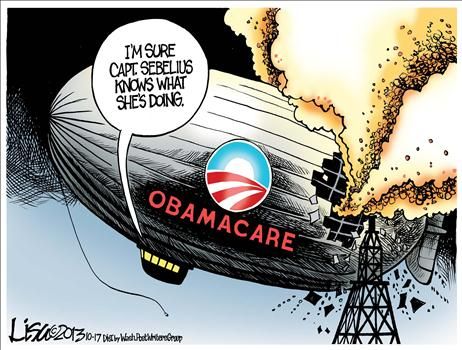
    Asked whether Kathleen Sebelius should be fired, [former Obama chief of staff Bill Daley] said: "To me that's kind of like firing Captain Smith on the Titanic after it hit the iceberg." The Titanic. Some will see his comments as disloyal. Actually they were candid and realistic. Although in fairness, the Titanic at least had three good days, and Edward Smith chose to go down with the ship.
    Then there's the Hindenburg:
    Lisa Benson cartoon
    Your humble observer is quite confident that healthcare.gov will be "fixed" by the end of November. A website can be set up in less than an hour, and a feature like user registration can be added in less than a day.

    More complex features, like enrollment with an insurance carrier, verifying taxpayer income and subsidies, and securing and encrypting data could take a lot longer than 45 days. However, because there is no published spec sheet the Administration will declare the project complete on November 30. The features that you or I are expecting, dear reader, will be in version 2.0, date to be determined. © 2013 Stephen Yuen

    Wednesday, October 16, 2013

    From Miles and Years Away

    0 comments
    A few comments about tonight's budget deal and the main source of contention, Obamacare:

  • There was no serious danger that the U.S. Government would default on its obligations. Too many powerful constituencies of both political parties would not have let it happen.
  • It was obvious from the beginning that Republicans would be blamed for the government shutdown:
    Of the 124 stories broadcast on the ABC, NBC and CBS nightly newscasts about the shutdown from Oct. 1 through Oct. 15, the [Media Research Center] study found 41 blamed Republicans or conservatives for the impasse, 17 blamed both sides and none specifically blamed Democrats.
  • The good news for Republicans is that the 24/7 news cycle operates in their favor. By next week their missteps should largely be forgotten, and news coverage will begin in earnest on Obamacare's woes (website freezes, premium rate hikes, security flaws, lost applications, etc.).

  • If the Republicans learned anything from this episode, they will make concessions during the next round of debt-limit negotiations in January and agree to fund Obamacare to a limited extent--perhaps the original 2014 projections made by the CBO when the law was passed in 2009. Republicans will appear reasonable, while the drip-drip-drip of Obamacare bad news could last into the November elections.

    Lest you think, dear reader, that I am rooting for the Patient Protection and Affordable Care Act to fail, the opposite is true. We are in the 55-to-65 cohort whose premiums will be thousands of dollars lower under the exchanges (in order to get the subsidy we have to manage our income down, which is easily arranged!).

    It's just that anyone with any experience working in organizations could see this train wreck coming from miles, and years away. © 2013 Stephen Yuen
  • Tuesday, October 15, 2013

    O, the Humanity

    0 comments
    An e-mail from the Yale Club [bold added]:
    We regret to inform you that the event at NASA Ames Center featuring astrobiologist Dr. Lynn Rothschild has been indefinitely postponed due to the federal government shutdown. We'll keep you posted if the event gets re-scheduled.
    Don't those Congressional extremists know the pain they're causing?

    Wednesday, October 9, 2013

    A Plausible, Good Deal

    0 comments
    Peggy Noonan on the "strange shutdown":
    Republicans, who hate big government, are fighting to keep it open, and Democrats, who love big government, are fighting to keep it closed.
    The Republicans want to fund everything but Obamacare, which is a sacred cow to Democrats; hence the impasse.

    In the short run everyone in Washington is looking bad, and the Republicans are looking worse. If this goes on much longer, however, the majority of Americans may find that they're getting along just fine if Washington is closed. Big government advocates are running a huge risk: benefits and taxes both stopping looks more and more like a plausible, good deal.

    Wednesday, October 2, 2013

    I Won't Pay You, But You Must Pay Me

    0 comments
    It has been our experience that most people still do the ethical--and legal--thing by living up to their contractual obligations when dealing with struggling businesses. However, one need not be stupid about it; if the financially troubled business owes us and we owe them money, we "offset" receivables and payables and pay them the net amount, if any. (Landlords netting repairs and security deposit refunds are probably the offset example that is most familiar.)

    But offset is not allowed when the other party is the government:
    “Tax refunds will not be issued until normal government operations resume,” said the IRS. The IRS emphasized, however, that the underlying tax law remains in effect, and all taxpayers should continue to meet their tax obligations as normal.
    The IRS won't pay you, but you must continue to pay it or be subject to jail and/or fines.

    Those who advocate more government, as opposed to private-sector, provision of services are in for a rude shock when they discover that the devil they threw out is replaced by a devil that is far worse because it doesn't have to worry about losing you as a customer or your poor Yelp review. © 2013 Stephen Yuen

    Friday, September 27, 2013

    A Crisis That Isn't

    0 comments
    Sooner or later one of these governance "crises" will have dire consequences, but your humble observer doubts that the impending October 1st shutdown of the Federal government will have different results from the sequester, the 2012 debt limit kerfuffle, or the 2012 U.S. Treasury downgrade. Some people, such as government employees, will be affected, but the rest of the country will probably just shake its collective head and hope that the stalemate does not go on too long.
    While there has been no government shutdown since 1996, there were 17 separate events in the previous 20 years so clearly the markets would not be too inconvenienced by a brief hiatus. Analysis by Rabobank found that the previous events had very little impact on bond yields. The famous 1995 shutdown did not make a dent in a roaring equity bull market.
    Undoubtedly the House Republicans will take most of the blame for the shutdown, but I can't fault them too much for their desperate and seemingly futile attempt to stem the tide of big government. Increased government control over medical care, education, and banking seems to have made the problems in those areas worse; the proposed solutions always involve more spending, prosecuting the "crimes" of the people working in those sectors, and more regulation and more laws.

    Someday lenders will stop lending, taxpayers will stop paying taxes, and government services will be shut down in earnest, but the good news is that it won't be this October 1st. © 2013 Stephen Yuen

    Monday, September 23, 2013

    We Don't Appreciate Them

    0 comments
    Former Secretary of Education and conservative commentator Bill Bennett is the latest to rail against Congress' exempting itself from Obamacare:
    Imagine the horror when these elected officials, who make $174,000 a year, realized that not only must they and their staffers be subject to inferior-quality health exchanges like the millions of ordinary Americans, but they might also have to shell out thousands of dollars for increased premiums if they exceed the subsidy income cutoff. [snip]

    Heaven forbid Congress suffer the same fate as private companies like UPS, which recently had to cut health-care benefits entirely for employees' spouses; or labor unions, like the 40,000 International Longshore and Warehouse Union workers who recently left the AFL-CIO citing as one factor ObamaCare's tax on their "Cadillac" health-care plans.
    It's also a shame that Congress and its staffers must pay income taxes, serve on juries, and abide the traffic laws. Let's hope that they're working on exempting themselves from those, too. The poor dears work so hard for us, and we don't appreciate them enough. © 2013 Stephen Yuen

    Thursday, September 5, 2013

    Not Balanced

    0 comments
    Insights about the surveillance society [bold added]:
    Princeton computer-science professor Edward Felten explained that this tremendous growth in storage capacity would inevitably spur intelligence agencies to collect all available data—everything—simply because it’s cheaper and easier than trying to figure out what to take and what to ignore. “If storage is free but analysts’ time is costly, then the cost-minimizing strategy is to record everything and sort it out later,” Felten noted. [snip]

    The more technology endangers our privacy, the less we seem to prize it. We post family photos on social-media sites and ship our credit-card numbers to total strangers. We ask websites we’ve never visited—designed by people we’ve never met—to give us advice on treating embarrassing maladies and hunting for potential mates. But the government is different, as [National Intelligence general counsel Robert] Litt acknowledged in his recent speech, because “the government has the power to audit our tax returns, to prosecute and imprison us, to grant or deny licenses to do business and many other things. And,” he continued, “there is an entirely understandable concern that the government may abuse this power.”
    The writer, David von Drehle, tries to end on a hopeful note:
    This, ultimately, may prove to be our strongest protection against the rise of the surveillance state. The same tools that strengthen it strengthen those who protest against it. Privacy is not the only illusion in the new age of data; government secrecy is too. Big Brother might be watching, but he is also being watched.
    However, as the article pointed out earlier, police, taxing, regulatory, and/or subpoena power resides with the government and private citizens have very little resources to counterbalance it. Knowledge is powerful, but knowledge needs a lot of help. © 2013 Stephen Yuen

    Tuesday, August 6, 2013

    Disturbing

    0 comments
    Late last night an emergency-alert siren could be heard throughout the house. It took a few seconds to realize that it wasn't coming from the TV or radio, and then a longer interval for us to determine that the sound was being emitted by our three smartphones. A state-wide amber alert had been issued for a murder and kidnapping that occurred earlier that day in San Diego.

    iPhone alerts are in Settings > Notifications
    The event introduced us and many other Californians to the newly instituted Wireless Emergency Alerts (WEA) program. There are three categories of "government alerts" fed to smartphones. Amber alerts and emergency alerts, which concern child abductions and natural disasters, respectively, can be turned off, while the channel for "presidential alerts" is always open.

    While we do understand that lives are at stake and sympathize with victims' families, the odds of us being able to help are very remote. (And is sending a blast of sound to millions of Californians at 11 p.m. so superior to the old method in getting results?) We'll fulfill our civic obligations the traditional way, by listening to the news and paying attention when we're out and about.

    We're open to arguments, but for now we're switching the alerts to off.

    [Update - 8/8: neither the suspect nor the kidnap victim have yet been found.]

    Tuesday, May 21, 2013

    Worry About Tomorrow Tomorrow

    0 comments
    Due to the requirements imposed on small businesses, Obamacare has been criticized as an impediment to job creation [update: large employers may be able to comply with Obamacare rules by using "bare bones" health plans that cover little hospitalization, if any.] However, the measure's job effects aren't totally negative [bold added]:
    To implement President Obama's Affordable Care Act, San Mateo County will hire 25 people to help process the expected flood of new applications for new benefits....San Mateo County's Health Services Agency has been advised to brace for about 894 new applications per month above the 2,276 it currently receives for health benefits.
    Further good news: half the annual labor cost of $3.6 million (that's an average of $144,000 per employee!) will be paid for by the Federal Government. The uncertain news: the jobs aren't expected to be permanent.

    However, such an objection is unlikely to dissuade County managers from hiring. For decades California governments have believed in spending and hiring and worrying about tomorrow when tomorrow comes, and their recent actions (e.g., installing high-speed rail where most of the people don't live) show that little has changed.

    Monday, March 11, 2013

    Portion Control

    0 comments
    90 calories, no corn syrup
    We've been drinking soft drinks for most of our lives, but ever-louder warnings from doctors have induced us to cut back consumption. We never warmed to the taste of diet sodas, which have health risks that their sugary brethren do not; substitution is no solution.

    When we absolutely must have some sweet fizziness, we turn to smaller cans of so-called "natural" sodas that purportedly contain fruit juices with no added sugar. They're more expensive than the popular brands, but dealing with diabetes would be much more costly.

    Despite my sympathy with Mayor Bloomberg's goals, I was happy to see that the deliciously named Judge Tingling stayed the implementation of New York City's regulations that would have banned large sugary drinks.

    In addition to the defects in a regulation that had glaring loopholes, the larger issue was whether the state had the power to regulate substances and activities that may cause long-term harm but did not threaten imminent danger to public health. Judge Tingling drew a welcome line in the sand. © 2013 Stephen Yuen

    Friday, March 8, 2013

    McArdle on Drug Addiction, Sequestration, and Unemployment

    0 comments
    A few of the postings by Megan McArdle this week. She always has interesting things to say.

    There's a Reason That Addicts Say Yes to Drugs
    But from talking to friends who developed more-than-recreational habits, and observing the behavior of addicts worldwide, it seems obvious that they do find the drugs even better than jobs, wives, friends, and health. It isn't that they don't want those other things, too, but at the moment of choice, they prefer the drugs. [snip]

    From the point of view of the addict, drugs are great. He doesn't have a drug problem: he has a reality problem.
    Comment: Drug addiction, although much worse, has this in common with over-eating--short-term pleasure too often overwhelms the long-term gain of abstinence.

    The Administration's Thin Complaints About the Sequester
    [re proven-to-be-false claims about teacher layoffs and janitor pay cuts]: these aren't matters of opinion where the administration can simply argue assumptions; these are easily checkable statements with hard numbers attached. From this I infer that the administration is having a hard time finding concrete examples of bad things that the sequester is going to do. Nor is that a huge surprise. Whether you're for or against the sequester, we are talking about relatively small sums, in the scope of the federal deficit. They're simply not going to show up in much measurable way as devastating hardship.
    Comment: we've said as much, along with thousands of commentators and politicians from both sides of the aisle. Why does an Administration with smart people (whether you agree with them or not) make such dumb claims that can quickly be disproved? They're dissipating their capital needlessly.

    The Federal Government Should Hire the Long-Term Unemployed [bold added]
    No, I'm not talking about WPA jobs (though I also think that those sorts of jobs would make a fine alternative to unemployment insurance). [snip]

    But even now, with governments cutting back, there are government vacancies being filled. Why not institute a special preference for people who experienced long-term unemployment between 2009 and 2013? We already have preferences for veterans and the disabled. It would be easy enough to make long-term unemployment a similar "plus factor". Unless you believe that the employer bias against the long-term unemployed is entirely rational--and I am pretty skeptical about this--then this sort of preference should be an all-around win. It wouldn't, by itself, be enough to solve the problem. But even a small start is worthwhile.
    Comment: one may think that there's too much public-sector spending and employment. However, as long as there are government vacancies, why not give a preference to the long-term unemployed? Of course, they still must be qualified to do the job.

    Friday, March 1, 2013

    Sequester, Sequestration: What's the Difference?

    0 comments
    Chart from the Wall Street Journal
    Suffixes do matter. Cas-ter and cas-tration have different meanings, nicht wahr? OK, enough silliness.

    Comments about the latest budget crisis:

    1) The sequester mandates cuts of $85 billion--about 2.4%--from a $3.55 trillion budget. This is equivalent to a middle class family coming up with savings of $120 on an income of $5,000 per month. It might be difficult in some cases, but catastrophic? Please.

    2) Because the sequestration occurs in the middle of the government's fiscal year, much has been made of how "these cuts must be achieved over only seven months instead of 12" (from the first page of the OMB report). This assertion assumes that the sequester took everyone by surprise; managers with any experience in the ways of Washington should have been underspending their first-half budgets to prepare for this eventuality, and it would be very surprising if most of them did not.

    3) Yes, the sequester is dumb because it leaves no room for judgment. Back to the example of the $5,000-per-month family trying to cut $120 from its spending: the family can not cut its mortgage payments, rent, or health insurance premiums by even a dime because of the severe consequences of a default, yet across-the-board sequester-like trimming could well trigger such an outcome. Nevertheless, I have a hard time believing that essential services won't somehow be funded, given potential workarounds afforded by the vast sums flowing through the government.

    4) If a federal buyer went to suppliers and asked if, say, 90-day payment terms could be stretched to 180 days temporarily, most suppliers would assent. It would be nice for them to be owed a favor by a government manager. From the government's point of view, what good is monopsony power unless you're willing to use it?

    5) Personal prediction over when the sequester and the debt ceiling will be resolved: Earliest - April 15 (symbolic); Latest - September 30 (end of the fiscal year). © 2013 Stephen Yuen

    Thursday, February 7, 2013

    Scandinavian Models

    0 comments
    An Economist special report lauds the Nordic countries for shrinking their welfare states without triggering economic and political turmoil. Nowhere is this trend more apparent than in Sweden, the poster child for European social democracy [bold added]:
    Sweden has reduced public spending as a proportion of GDP from 67% in 1993 to 49% today. It could soon have a smaller state than Britain. It has also cut the top marginal tax rate by 27 percentage points since 1983, to 57%, and scrapped a mare’s nest of taxes on property, gifts, wealth and inheritance. This year it is cutting the corporate-tax rate from 26.3% to 22%. [snip]

    Its public debt fell from 70% of GDP in 1993 to 37% in 2010, and its budget moved from an 11% deficit to a surplus of 0.3% over the same period. This allowed a country with a small, open economy to recover quickly from the financial storm of 2007-08. Sweden has also put its pension system on a sound foundation, replacing a defined-benefit system with a defined-contribution one and making automatic adjustments for longer life expectancy.

    Most daringly, it has introduced a universal system of school vouchers and invited private schools to compete with public ones. Private companies also vie with each other to provide state-funded health services and care for the elderly.
    The Nordic countries are not dismantling the welfare state but are asking themselves how its benefits can best be provided, then acting on their judgments. For example, if vouchers produce a quality education at lower cost, then the rationale for having government provide, as well as pay for, universal education is shattered. [Closer to home: a Stanford University study concluded that "Detroit school children are learning at a rate of an extra three months in school a year when in charter public schools compared to similar counterparts in conventional Detroit Public Schools."]

    The Economist contends that the Nordic countries have succeeded because of transparency, pragmatism, tough-mindedness, and a common set of values:
    in Sweden everyone has access to all official records. Politicians are vilified if they get off their bicycles and into official limousines.

    The combination of geography and history has provided Nordic governments with two powerful resources: trust in strangers and belief in individual rights.....Economists say that high levels of trust result in lower transaction costs—there is no need to resort to American-style lawsuits or Italian-style quid-pro-quo deals in order to get things done. But its virtues go beyond that. Trust means that high-quality people join the civil service. Citizens pay their taxes and play by the rules. Government decisions are widely accepted.
    The combined population of Denmark, Finland, Norway, and Sweden is 26 million, less than the total population of California. Whether their example can be applied on a continent-wide basis is problematic, but at least they have shown that it can be done. © 2013 Stephen Yuen