 |
| Image and article from Quanta magazine |
Entia non sunt multiplicanda praeter necessitatem.
|
| Image and article from Quanta magazine |

 |
| The shift is on. |
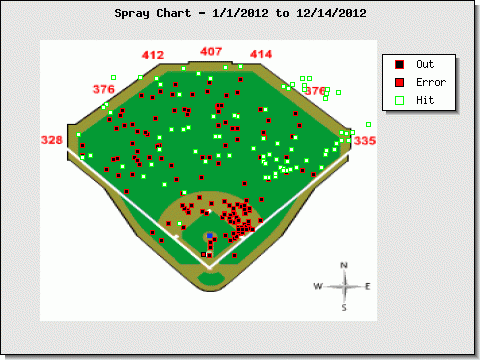 |
| Kubel's spray chart |
A new report, "The Hidden STEM Economy," reveals that a university degree is not required for 27.5 percent of all jobs in the San Jose area in the fields of science, technology, engineering and math. The number is even higher -- 36 percent -- in San Francisco and the East Bay. [snip]It won't be easy, one may have to defer one's "real" calling, and one may have to swallow some pride initially because of lower pay and status, but after a few months on the job most co-workers won't care about where or even if one went to college. In the pay-for-performance economy it's remarkable how many people succeed once they get in the door.
Drawing from high schools, vocational schools and community colleges, these jobs pay annual salaries averaging $73,000 [note: the national average is $53,000]-- less than positions requiring a university degree, but $30,000 a year more than those in fields outside science, technology, engineering and math.
 |
| University of Arizona graphic |
Eric Weinstein gave a lecture at Oxford in which he outlined a theory that he has apparently been working on for a number of years. [It] is an attempt at a Theory of Everything — specifically, a theory that would unify the standard model of particle physics with general relativity, explain dark matter and dark energy, and basically provide a synthesis that would resolve many of the big questions facing physics today.The greatest minds from Einstein to Hawking have been struggling to construct the Theory of Everything, and it's very unlikely that a non-physicist has come up with major new insights, much less The Answer. Of course, it was more unlikely that, just over a hundred years ago, a Swiss patent-office clerk would revolutionize the way we look at the universe.
This sort of thing is always exciting. But this proposal gained particular attention for the fact that Eric Weinstein is not a Physics professor. Yes, he has a PhD in math from Harvard, but he has been out of academia for twenty years, and his day job is at a hedge fund in New York.
Now nearly every team in the NFL has an analytics group, though most are as forthcoming as the CIA regarding the work these employees perform. [snip]It's nice to know that the San Francisco 49ers are second to none in the analytics arms race:
Among those teams riding the stats wave are the Ravens, who announced in August that they'd hired a former NBA statistical consultant with degrees from Yale and Carnegie Mellon to lead their new analytics department. They're just now catching up to opponents like the Patriots, and the 49ers, who in 2001 lured Stanford M.B.A. Paraag Marathe from his consulting job at Bain & Co. to lead their analytics department.
"There's one team right now that is applying all of this better than everyone else, and that is San Francisco," says [Jaguars executive Tony] Khan. He points to one 49ers play in Week 10, against the Rams: San Francisco faced fourth-and-one at St. Louis's 21-yard line, down 10 in the fourth quarter. The Niners went for it, converted and scored a touchdown two plays later. The game ended in a 24-24 tie. "Most people disagreed with that," says Khan. "But I've seen the chart they use. And certainly guys like [pioneering football statistician] Brian Burke agreed with what they did."Although the article is about football, the writer throws some love at the baseball Giants:
Throughout professional sports, forward-thinking teams are engaged in an arms race for new technology that can lend them any advantage. The most progressive organizations have quietly begun incorporating video technology into their analysis: Fieldf/x, which tracks players' movements on the baseball field, has been a secret weapon for the world champion San Francisco Giants; and 10 NBA teams use SportVU, which can identify opposing teams' plays based on movements. NFL teams are starting to use similar technology: This year the Falcons, Giants and Jaguars began using GPS tracking technology on their players during practices. (The league prohibits it during games.)Note: The local basketball team, the Golden State Warriors, uses video-capture technology from Sportvu (aka Stats LLC). Perhaps Titletown will be here sooner than we thought. © 2012 Stephen Yuen
