Showing posts with label Computer. Show all posts

Wednesday, October 30, 2013

Just Science Fiction

0 comments
One of the unanswered mysteries in 2001: A Space Odyssey: Why did the HAL 9000 supercomputer malfunction and murder nearly the entire crew on the trip to Jupiter?

In the sequel 2010: Odyssey Two it was explained that
HAL's crisis was caused by a programming contradiction: he was constructed for "the accurate processing of information without distortion or concealment", yet his orders.....required him to keep the discovery of the Monolith TMA-1 a secret for reasons of national security.
HAL's architecture was based on openness and transparency, but government higher-ups ordered HAL to conceal important information from the crew. HAL went through the computer equivalent of a psychotic break.

Forbes [bold added]:
In the case of Obamacare, the web site was made needlessly complex just in order to avoid this sort of transparency [as programmed into Medicare Part D]. There was probably fear in the White House that if consumers browsed plans and saw the list cost (without first knowing how much the government would subsidize their plan) many people would not return.
At the end of 2001 sole survivor David Bowman performs a "lobotomy" on HAL to save the ship. Bowman finishes the mission by operating everything manually. Human beings having such resourcefulness, however, is probably just science fiction. © 2013 Stephen Yuen


Thursday, October 24, 2013

Glitches, Icebergs, and Other Metaphors

0 comments
On October 1st President Obama compared Obamacare's rocky start to problems that Apple encounters---and fixes--whenever it rolls out a new product [bold added]:
[On] every new product roll-out, there are going to be some glitches in the sign-up process along the way that we will fix....And we're going to be speeding things up in the next few hours to handle all of this demand that exceeds anything that we had expected. Consider that just a couple of weeks ago, Apple rolled out a new mobile operating system, and within days, they found a glitch, so they fixed it.
When Apple has a "glitch," even one as bad as last year's Apple Maps or the antenna problem in 2010, it fixes the problem or offers a substitute within a matter of weeks. The market eventually (re)embraces Apple's products as second to none in quality and aesthetics.

An Apple glitch is like the mole on Cindy Crawford's cheek: hardly
noticeable in light of other favorable attributes. (China Daily photo)
Commentators have been less forgiving in their metaphors. Peggy Noonan:
(WSJ Graphic)
The ObamaCare rollout is a disaster for the White House, not a problem or a challenge or an embarrassment, not a gaffe or a bad few weeks. [snip]

Asked whether Kathleen Sebelius should be fired, [former Obama chief of staff Bill Daley] said: "To me that's kind of like firing Captain Smith on the Titanic after it hit the iceberg." The Titanic. Some will see his comments as disloyal. Actually they were candid and realistic. Although in fairness, the Titanic at least had three good days, and Edward Smith chose to go down with the ship.
Then there's the Hindenburg:
Lisa Benson cartoon
Your humble observer is quite confident that healthcare.gov will be "fixed" by the end of November. A website can be set up in less than an hour, and a feature like user registration can be added in less than a day.

More complex features, like enrollment with an insurance carrier, verifying taxpayer income and subsidies, and securing and encrypting data could take a lot longer than 45 days. However, because there is no published spec sheet the Administration will declare the project complete on November 30. The features that you or I are expecting, dear reader, will be in version 2.0, date to be determined. © 2013 Stephen Yuen

Wednesday, October 23, 2013

Three Weeks Later

0 comments
From President Obama's October 1st remarks on the government shutdown and the Obamacare rollout:
starting today, you and your friends and your family and your co-workers can get covered too. Just visit healthcare.gov, and there, you can compare insurance plans side-by-side the same way you'd shop for a plane ticket on Kayak or a TV on Amazon. You enter some basic information, you'll be presented with a list of quality, affordable plans that are available in your area with clear descriptions of what each plan covers and what it will cost.

You'll find more choices, more competition and in many cases, lower prices. Most uninsured Americans will find that they can get covered for $100 or less. And you don't have to take my word for it, go on the website, healthcare.gov, check it out for yourself and then show it to your family and your friends and help them get covered just like mayors and churches and community groups and companies are already fanning out to do across the country.

And there's a hotline where you can apply over the phone and get help with the application. Or just get questions that you have answered by real people in 150 different languages. So let me give you that number. The number is 1-800-318-2596 -- 1-800-318-2596. Check out healthcare.gov, call that number, show your family and friends how to use it and we can get America covered once and for all so that the struggles that these folks have gone through and millions around the country have gone through for years finally get addressed.
Normally I would underline the phrases that events made ironic, but just imagine the whole passage as underlined.

Thursday, August 22, 2013

Doing Less Doesn't Mean Doing Nothing

0 comments
August 20
"Goldman Sachs experienced a trading glitch Tuesday that resulted in a large number of erroneous single stock and ETF options trades. Many of the trades may wind up being erased but the error could still cost the firm upwards of $100 million..."

August 22
"Trading in thousands of U.S. stocks ground to a halt for much of Thursday after an unexplained technological problem shut down trading in Nasdaq securities, the latest prominent disruption to the operations of U.S. markets."

Flatline? no just the NASDAQ freeze (WSJ Graphic)
Tech advances have made capital markets more accessible to the public than ever before, but so-called "glitches" keep happening.  The "Flash Crash" of 2010, when the Dow Jones Industrial average plummeted almost 1,000 points in a few minutes then quickly recovered, was and is alarming because there hasn't been a definitive explanation as to the cause, much less assurance that it won't happen again.

Small investors in the stock market should never place market orders because prices can change too suddenly. In other words, whether buying or selling, always place limit orders (where the price is specified). And if one no longer receives paper reports, one should make it a habit to download and store statements, instructions, and other correspondence on a hard disk or memory stick. One never knows when one may need to back up a transaction.

We live in the quick and convenient electronic age, but just because we do less doesn't mean that we do nothing. © 2013 Stephen Yuen

Friday, July 19, 2013

More Than Numbers

0 comments
The shift is on.
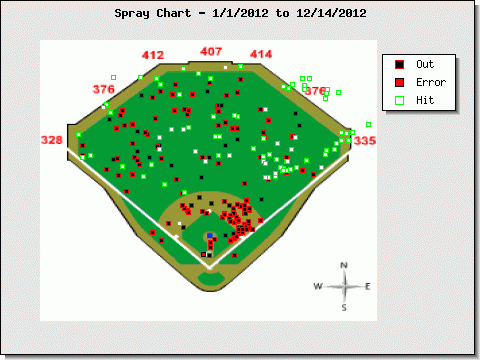
With the home team hanging on to a 2-0 lead, Giants closer Sergio Romo took the mound in the top of the ninth. Diamondbacks left fielder Jason Kubel was the first batter up, and the shift was on.

The Giants moved shortstop Brandon Crawford to the right of second base, and third baseman Pablo Sandoval was all by his lonesome on the left side of the infield.

Kubel's spray chart
Jason Kubel is a left-handed "pull" hitter who is almost incapable of hitting the ball left when he faces right-handed pitching. True to form, he flew out to right field.

Before Sabermetrics became widely employed, managers made decisions based on personal experience, gut feel, and scouting reports. Now no one makes a move without extensive data collection and number crunching. Though rooting for the Giants, I was secretly hoping to see Jason Kubel hit the ball to left field to show that man is more than numbers.

By the way, the Giants did win, 2-0. © 2013 Stephen Yuen

Saturday, June 8, 2013

The Age of the Philosopher King

0 comments
The ship has sailed, the barn door is open, the genie can't be put back in the bottle---use whatever metaphor you like. The government knows more about us than we had imagined, and soon, with ever-faster processors, ever-increasing storage capacity, and ever-more-powerful analytical tools it will know everything. If people didn't see this coming ten years ago, they weren't paying attention. But that's beside the point. They can't stop it.

When individuals have enormous power at their disposal, we try to make sure they do not misuse it by imposing physical safeguards (e.g., ICBM's) and legal restraints (e.g., a declaration of war is made by Congress, not the Commander-in-Chief). Systems of control, however, are as imperfect as the human beings who designed them. While improper behavior should be detected and corrected, the first line of defense must be to install people who have a strong ethical code, the right set of priorities (e.g., country before party, other people before oneself) and good judgment.

The American founders did their best to design a political system that did not require its leaders to have a moral character superior to the rest of society. However, when we consider the damage that could arise from the "wrong people" being in charge of, say, nuclear weapons or the Federal Reserve, then the corrective of replacing the government after four years seems woefully inadequate.

We are left with the solution that Plato proposed thousands of years ago, that of entrusting leadership to the philosopher-king:
we must make our guardians philosophers. The necessary combination of qualities is extremely rare. Our test must be thorough, for the soul must be trained up by the pursuit of all kinds of knowledge to the capacity for the pursuit of the highest--higher than justice and wisdom--the idea of the good.
"The idea of the good" is nowhere to be found on the Civil Service application for a job at the NSA. In fact the opposite behavior may well have been evidenced by the IRS. And that is why a lot of people are scared. © 2013 Stephen Yuen

Wednesday, May 8, 2013

All You Need is Space

0 comments


L to R: Windows 8, Windows 7, Windows XP

WSJ tech columnist Walt Mossberg reviews two products that allow Windows 8 users to use the old Start screen. To this longtime Windows user it is like installing a new engine in an old car: go old or go new, but in-between is esthetically jarring.

As for me, very few applications need the latest equipment, so I keep a bunch of old machines running. All you need is space....and a tolerant roommate. © 2013 Stephen Yuen

Sunday, May 5, 2013

Technology Not Settled

0 comments
Devices that I use now:
  • iPhone 5 (2012)
  • iPad 2 (2011)
  • MacBook Pro (2009)
  • Gateway SX - Windows 7 (2008)
  • Dell Vostro - Windows XP (2007)

    My mobile devices are fairly up to date, but the desktop and laptop machines are getting long in the tooth. WSJ tech reviewer Walt Mossberg surveyed the computer landscape and advises:
    Alas, I'm sorry to report, it's still pretty confusing and frustrating to buy a new laptop....

    For a high-quality, traditional laptop without a touch screen, you can't do much better than a MacBook Air, if you have at least $999 to spend. On the Windows side, stick with touch screens and be prepared to spend nearly as much, or even a bit more. But if you can wait, come back in the fall.
    Good advice. I've found that with computer purchases it's always better to wait as long as one can before upgrading. Also, the technology should be well enough settled so that the purchase will not be regretted two years later. I'll hold off opening my wallet. © 2013 Stephen Yuen
  • Wednesday, May 1, 2013

    Half-guilty As Charged

    0 comments
    Yesterday's post used "disruptive" and "disruption" to describe the impact of 3D printing, and I apologize for using a term that is now an overused cliché:
    [Disruption has] become an all-purpose technology industry buzzword, drained of meaning. A “synergy” for our time.
    The complaining writer defines the proper use of the term, at least from his point of view [bold added]:
    What makes disruptive innovations so deadly is they’re not better than your product. They’re worse. Anyone who needed a mainframe at the dawn of the personal computer era would find a PC to be an incredibly lame and underpowered alternative. So you ignore the alternative in favor of meeting the needs of your customers and perfecting your product. But the disruptive product keeps iterating and improving and selling to people who didn’t need mainframe computers but who do have use for a cheap, flexible PC. Soon enough, the PC market has swamped the mainframe market and your firm is on its last legs. You’ve fallen victim to the innovator’s dilemma: Your own success in the mainframe market blinded you to the real trajectory in the industry.
    Well, at least I used the term properly. The output of 3D printing is far below the detail and quality of a machine shop, but the speed and low cost make the tradeoff compelling to many would-be Edisons. In fields as diverse as photography, music, fashion, and education traditional methods may still be best at the very top, but for the vast majority of uses digitization indeed proved to be disruptive.

    Speaking of disruption and the old ways, Happy May Day, everyone. © 2013 Stephen Yuen

    Friday, April 5, 2013

    Wrong Career Choice

    0 comments
    Hope they disinfect stuff that's recovered
    (Examiner photo)
    It's almost a relief to take a break from all the horrific violence in the news to read about a one-man Bay Area (nonviolent) crime wave [bold added]:
    A “smooth-talking” thief has reportedly been posing as a customer at various businesses across the region and distracting employees in order to swipe cellphones and tablets off desks.

    The thefts have been going on for weeks, but their extent wasn’t realized until the South San Francisco Police Department reported to the media about five incidents there and three in Burlingame.
    We shouldn't make too light of this guy, because stealing a laptop or cellphone with sensitive personal and business information can be very damaging to the victim. And "in Daly City, according to police there, he went so low as to rob an employee of an assisted living facility."

    Nevertheless, one can't help but wonder at his choices.
    “He goes in, engages in long conversations and tries to gain their trust,” [Det. Mike] Garcia said. “He’s a real smooth talker, and apparently looks very clean cut.”
    What's he doing ripping off iPads? He could have been very successful in marketing or politics. © 2013 Stephen Yuen

    Wednesday, March 6, 2013

    Late to the Gold Rush

    0 comments
    So much big, early money had been made in mobile-device applications that the industry came to resemble a latter-day gold rush. Sure, it's likely there will be more "killer apps" released in the future, but with low barriers to entry the competition has become extremely fierce.

    App development now resembles the entertainment and publishing industries, which have a few enormously wealthy celebrities at the top, a sizable minority in the middle, and the majority at subsistence wages, if that. From a survey of app game developers the NY Times writes:
    the app world is an ecology weighted heavily toward a few winners. A quarter of the respondents said they had made less than $200 in lifetime revenue from Apple. A quarter had made more than $30,000, and 4 percent had made over $1 million.
    My friend has been working on an iPad app as a supplement to his consulting business. The process is fascinating, but we
    lack the technical know-how to build mobile apps on [our] own. The options range from using online app-building tools, to taking crash courses in computer programming and coding languages, hiring a costly professional on contract, or recruiting a full-time developer.
    So we've opted to pay for outside help. In the past year all three staffpersons assigned to our project have left (separately) for greener pastures. Partly out of self-preservation and partly out of curiosity we are slogging through technical manuals and code, even trying our hand at simple app-writing.

    We're a little late to the party, but the lure of app gold in them thar' hills is irresistible. © 2013 Stephen Yuen

    Wednesday, December 5, 2012

    One Problem Solves Another

    0 comments
    Anyone who has cassette tapes, floppy disks, or 8MM film should be concerned about the problem of data loss. Not only are the tapes, disks, and film deteriorating, but machines that can read the data are also increasingly hard to find. The phenomenon of obsolete media highlights the following general problem [bold added]:
    All interfaces and formats eventually die. Data storage consultant Tom Coughlin, founder of Coughlin Associates, calls it a fight against nature, saying, "the laws of thermodynamics are against you."

    Such a battle makes for a hazy long-term outlook. Will your data be accessible in 100 or even 50 years? Perhaps, but those data will likely be in different formats and will certainly be stored on different media than they are today. All modern-day technologies grow obsolete; either the hardware breaks or is replaced by something better, or new software takes over for the old, or both. In 50 years you may have a computer that can read PDFs, but you might have those PDFs stored on a medium the computer can't read. Or the opposite may happen, with data stored on a readable format but saved in long-gone file formats. The key to preventing either case is accepting the nonstop job of staying technologically up to date.
    The Popular Mechanics article says that there are no easy solutions. Data can be preserved by moving it to the latest media and backing it up in more than one location. That's a lot of work and conscientiousness demanded from a public that's used to computers making our lives easier, not more difficult.

    But Big Government may have a solution to the data-loss problem (it didn't set out to do that, of course).
    The FBI records the emails of nearly all US citizens, including members of congress, according to NSA whistleblower William Binney. In an interview with RT, he warned that the government can use this information against anyone. [snip]

    RT: You say they sift through billions of e-mails. I wonder how do they prioritize? How do they filter it?

    WB: I don’t think they are filtering it. They are just storing it. I think it’s just a matter of selecting when they want it. So, if they want to target you, they would take your attributes, go into that database and pull out all your data. [snip]

    [President Obama] is supporting the building of the Bluffdale facility, which is over two billion dollars they are spending on storage room for data. That means that they are collecting a lot more now and need more storage for it. That facility by my calculations that I submitted to the court for the Electronic Frontiers Foundation against NSA would hold on the order of 5 zettabytes [blogger's note: approximately 5 billion terabytes] of data.
    All your e-mails, including attachments, are preserved by the government. You can't access them today, but someday in a more open clime you or your descendants may be able to. So take the contents of your floppy disks, e-mail them to yourself, and take the disks and their drives to the electronic recycler. © 2012 Stephen Yuen

    Monday, November 12, 2012

    Protection Racket

    0 comments
    A family member clicked on an email attachment, and the computer screen exploded with pop-up boxes. The Family PC had become infected with malware.

    The ironically named System Progressive Protection repeatedly warns that one's computer has been invaded by a virus. A credit-card payment to SPP would supposedly remove the "virus" but really just de-activates the bogus warnings. Worse, the protection payment itself opens up the victim to identity and credit-card theft.

    There are various legitimate programs that would eradicate SPP, but I didn't feel like purchasing and adding yet another program to our creaky five-year-old Dell Vostro. Because we had been regularly backing up the Dell to an external hard drive, it was possible to fix the problem the hard and perhaps better way.

    Erasing the internal drive and reloading Windows XP from a set of original 2002 CDs was fairly easy. However, it took three days to download and install the various updates, including lengthy "service packs", from Microsoft. After we reloaded other software, such as the Office (Word, Excel, PowerPoint) suite, the backup drive restored the data.

    The whole episode is not something we would go through voluntarily, but at least by clearing away leftover code and unused programs the PC is working better than it has in a long time. We won't have to replace it this year after all.

    [Note: Microsoft no longer supports Windows XP, and it's not clear how much longer the service packs and updates will be available for download. The Dell has maybe two more years of useful life.] © 2012 Stephen Yuen